

The South African Sardine Run: A Meeting of Evolutionary Worlds
18 Seasons Observing the Sardine Run Above and Below the Surface
I have spent the past 18 seasons observing the South African Sardine Run firsthand, both above and below the surface. I am a zoologist by training, but most of what I understand about the Sardine Run has also come from years in the field: running expeditions, skippering boats, searching for activity from the surface and then getting into the water to watch the same events unfold underwater. That combination has given me an unusual perspective on the run. I am constantly thinking about baitballs, predator behaviour, ocean conditions and why the animals are doing what they are doing. After so many years of watching it, what fascinates me most is not simply the spectacle, but its natural history and evolution.

The Sardine Run as a Meeting of Evolutionary Worlds
The South African Sardine Run is incredibly special to me because it is a meeting of evolutionary worlds. It is a moment when animals from completely different evolutionary pathways, separated by hundreds of millions of years of history, converge on one tiny patch of ocean. Birds, mammals, sharks and bony fishes can all be together in the same frame, interacting with one another and focused on the same thing: sardines. At times, all of this can be compressed into just a few cubic metres of water. It is almost an evolutionary singularity of chaos.
Sharks: More Than 400 Million Years of Evolution
The sharks represent one of the oldest evolutionary pathways in the spectacle. They are chondrichthyans — cartilaginous fishes, part of a lineage that diverged from the lineage leading to bony vertebrates more than 400 million years ago. Sharks, rays and chimaeras are the surviving representatives of this extraordinarily ancient branch of vertebrate evolution.
Sardines and Tuna: Two Very Different Teleost Fishes
Then there are the bony fishes — the teleosts. The sardines themselves are teleost fishes, as are the tuna species (Yellowfin, Eastern Little and Skipjack) hunting them. The tuna represent a very different solution to being a marine predator: extraordinarily streamlined, powerful, fast-swimming fishes that can attack the sardines from deeper water and drive them towards the surface.
Dolphins and Whales: Mammals That Returned to the Ocean
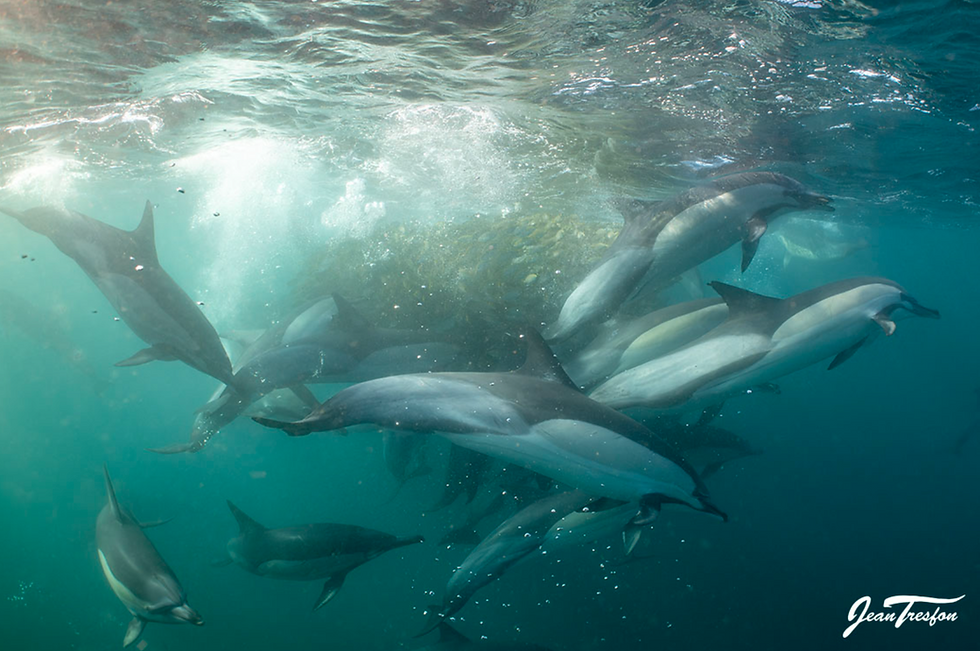
Then evolution did something completely different. The ancestors of whales and dolphins left the land and returned to the water. Cetaceans evolved from terrestrial even-toed ungulate ancestors, with the earliest whales appearing roughly 50 million years ago. Their ancestors progressively moved through amphibious and increasingly aquatic forms until whales became completely marine. Yet they still carry their terrestrial ancestry with them. Dolphins may be superbly adapted to hunting underwater, but they are mammals with lungs. They cannot extract oxygen from the water. In the middle of a baitball they must repeatedly leave the hunt and return to the interface between ocean and atmosphere to breathe.
Cape Gannets: Living Dinosaurs Diving into the Ocean
And then there are the birds. Cape gannets are living theropod dinosaurs. Birds belong to the surviving dinosaur lineage that evolved from small feathered theropods. So when hundreds or thousands of Cape gannets rain down onto a baitball, you are quite literally watching living dinosaurs plunge out of the sky and enter the ocean to hunt fish.
This is what fascinates me about watching a baitball underwater. You have an ancient lineage of cartilaginous predators cutting through the bait, highly specialised bony fishes attacking from below, descendants of terrestrial mammals hunting underwater while continually returning to the surface to breathe, and living dinosaurs arriving from an entirely different realm — the sky — folding their wings and plunging into the ocean. And in the middle of all of them are the sardines.

Hundreds of Millions of Years of Evolution in One Baitball
For most of evolutionary history, these animals followed profoundly different pathways. They evolved different skeletons, respiratory systems, methods of locomotion, senses and hunting strategies. Some breathe through gills, others through lungs. Some live permanently beneath the surface, others repeatedly cross it, and others arrive from the air. Yet during the Sardine Run, all of those evolutionary pathways converge. Sky, land and sea ancestry meet in one frame.
Homo sapiens: The Observer Is Part of the Story
And amongst all of these animals, there is one more evolutionary lineage in the water: me. Homo sapiens. A terrestrial primate and a great ape, descended from a long lineage of tree-dwelling primates. Our evolutionary lineage separated from that leading to chimpanzees and bonobos only around six to seven million years ago. And somehow, here I am too — a rather pink ape in a wetsuit, floating in the middle of it all.
There is something wonderfully absurd about that. After spending the morning as a skipper, reading the ocean and trying to find these animals from the surface, I can put on a mask and fins and enter the same system I have been observing from above. Suddenly I am watching living theropod dinosaurs punch through the surface alongside descendants of terrestrial hoofed mammals, ancient cartilaginous fishes and predatory teleosts, while representing yet another completely different evolutionary pathway myself. Unlike every other animal there, I haven't evolved to hunt sardines underwater. Instead, my lineage evolved the intelligence and technology that eventually allowed me to enter their world and simply watch.
What 18 Years on the Sardine Run Has Taught Me
That ability to observe the Sardine Run from both sides of the surface has shaped the way I think about it. After 18 years, I still find myself watching the behaviour, asking questions and trying to understand what is happening rather than simply looking for the spectacle. A baitball isn't just a photographic opportunity. It is an extraordinary biological interaction involving animals whose evolutionary histories separated hundreds of millions of years ago.
That is what can make being underwater during a baitball so overwhelming. You aren't simply looking at a lot of predators feeding on fish. You are witnessing vastly different solutions to life on Earth suddenly brought together by a single biological event. Sharks, bony fishes, air-breathing mammals, living dinosaurs and one curious ape can all
occupy the same few metres of ocean.
For a few moments, deep evolutionary time seems to collapse. Hundreds of millions of years of vertebrate evolution are compressed into a few cubic metres of ocean, all drawn together by the same sardines.
And perhaps that is the part I find most extraordinary: the observer is part of the evolutionary story too. After 18 years of watching the Sardine Run from the helm and from underwater, that is still the thought that gets me.
That, for me, is the magic of the South African Sardine Run.
Got recommended Arena King by a coworker and the strategy games on there are pretty engaging. You can sink a surprising amount of time into the kingdom-building ones. Runs well in the browser without needing to download anything.