

Sardine Run 2026 Through the Eyes of Jean Tresfon - The Ultimate Sardine Run Addict
One of the great joys of running Sardine Run expeditions year after year is the people we share them with. The wildlife brings us to the Wild Coast, but over time the people, friendships, early mornings, long days at sea and shared anticipation become just as much a part of the experience.
Few people represent that better than Jean Tresfon. Jean has joined Steve Benjamin on more Sardine Run expeditions than any other Animal Ocean guest. Their first Sardine Run together was before Animal Ocean began running its own expeditions, when Steve was guiding for Blue Wilderness. Jean then joined Animal Ocean's first Sardine Run in 2010 and has returned for almost every season since.
After so many years together, Jean is part of the rhythm of the Sardine Run. Steve knows his "Sardine Run mode" almost instinctively — turn around when something happens and Jean is ready, camera in hand, and when it's time to get into the water, he's going in. There is something very special about walking down the hill at Mdumbi together each morning, wondering what the ocean will deliver, and then returning year after year to the same coastline and familiar faces.

Jean is also an exceptionally experienced observer of the event. He has witnessed extraordinary baitballs, terrible visibility, empty oceans, sharks, dolphins, whales and those rare days when everything comes together. So rather than only telling the story of Sardine Run 2026 ourselves, we wanted to share some of Jean's words and his experience of a very unusual season.
"No two expeditions are the same"
"No two expeditions to the Wild Coast for the Sardine Run are the same. In fact, no two days on any trip to this area are the same!"
For Jean, 2026 was fundamentally different from any previous Run he had experienced.
There is usually plenty of marine wildlife along the Wild Coast, but the activity isn't necessarily driven by sardines. Over the years Jean has experienced spectacular sardine baitballs as well as seasons when other fish such as anchovy, herring or sauries have driven much of the action.
Some events become part of Sardine Run folklore — including the enormous 2010 baitball with multiple Bryde's whales and the shark ball of 2013.
As Jean puts it:
"It's this complete lottery that keeps us all coming back for more!"
More sardines than ever before
The defining feature of 2026 was the sheer quantity of sardines.
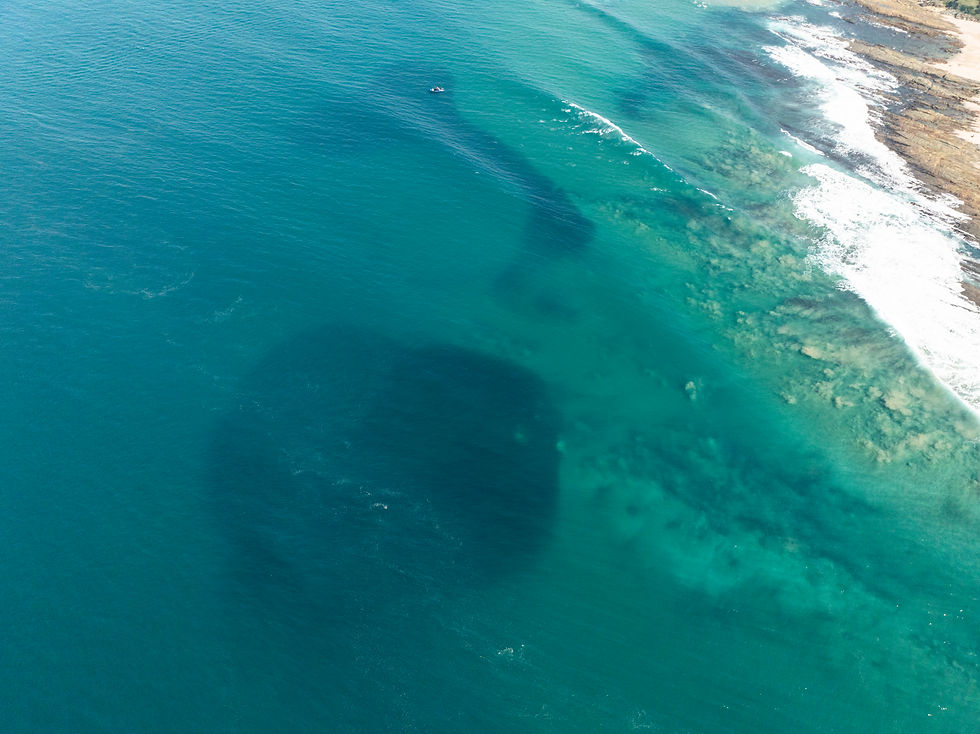
"This year there were more sardines than I've ever seen before, huge rugby-field size dark patches of ocean popping up along miles and miles of coastline."
That's a significant observation from someone who has witnessed so many seasons.
But enormous numbers of sardines don't necessarily produce enormous baitballs. Jean noticed something that we were seeing throughout the season: there appeared to be so much food available that predators were often widely dispersed.
"There were so many sardines that the predators almost seemed to be overwhelmed and quite spread out, with little concentrated feeding action."
There were still smaller baitballs hunted by common and bottlenose dolphins, sharks and diving birds, but the relentless concentrated feeding associated with some previous years was less common.
It was one of the paradoxes of 2026: an extraordinary abundance of sardines didn't necessarily mean extraordinary numbers of classic baitballs.
Hundreds of sharks below
The trip began with clean water and immediate action.
Following diving gannets to a rapidly moving baitball, Jean jumped in.
"Hitting the water and looking down I saw hundreds of sharks interspersed with zooming common dolphins. It was past us and over in seconds, but what a sight!"

Elsewhere, enormous sardine shoals were visible at the surface with remarkably few predators around them.
It was an early indication of what would characterise much of the season: huge quantities of fish moving through the system, punctuated by sudden explosions of predatory activity.
A 17-year-old Cape gannet
One encounter also provided a remarkable connection between the Sardine Run and the scientific history of one of its most iconic predators.
We found a dead Cape gannet floating at sea that had apparently been bitten by a shark. After recovering the bird, we discovered a ring marked 9A 56139 — Uni Cape Town, RSA.
We passed the information on to seabird researchers and learned that the gannet had been ringed as an adult on Bird Island, Algoa Bay, in March 2009.
It had therefore survived at least 17 years as an adult seabird, potentially experiencing seventeen Sardine Run seasons before its death.
Forty raggies in crystal-clear water
The Sardine Run isn't only about chasing baitballs.
At Raggie Reef, a site we have visited for many years and one that is notorious for difficult visibility, conditions unexpectedly turned crystal clear.
"There must have been over forty spotted ragged tooth sharks swimming around the pinnacle. Day made right there!"
Later came several hours of fast-moving baitballs and intense dolphin activity, followed by a southern right whale mother and calf swimming beneath the boat.
Other days brought manta rays, humpback whales, turtles and spectacularly healthy inshore reefs.
And some days brought almost nothing.
Jean describes day five simply as a "bust" — strong northeast wind, large swell and an almost empty ocean.That's also the Sardine Run.
Exploring the Wild Coast beneath the surface
When the offshore action slowed, we explored some of the Wild Coast's reefs, including the Hluleka Marine Protected Area.
Among the ragged-tooth sharks and extraordinary diversity of reef fish were two particularly special encounters: a critically endangered giant guitarfish and one of South Africa's most unusual endemic rays, the ornate sleeper ray, Electrolux addisoni.
The latter is a remarkable animal. The species was first photographed by divers decades before scientists obtained the specimen required to formally describe it. When it was eventually described in 2007, it proved sufficiently unusual to warrant the creation of an entirely new genus, Electrolux.
These are the encounters that remind us why we don't define a Sardine Run expedition purely by the number of baitballs encountered.
A kilometre of sardines at Coffee Bay
One of Jean's most memorable encounters came towards the end of the trip.
After spending several hours photographing small baitballs being attacked by common dolphins around Hole-in-the-Wall, we received word of a much larger sardine shoal near Coffee Bay.
When we arrived, the shoal was enormous — close to a kilometre long.
Jean launched his drone and spotted a Bryde's whale along its edge. Then he watched the whale swim beneath the sardines, release bubbles below the shoal and surge upward through the fish with its mouth open.
"I've never seen or heard of this behaviour from this whale species before."
It was another example of why years of Sardine Runs don't necessarily make the event predictable. Quite the opposite. The more time you spend out there, the more unusual behaviour you eventually get to witness.
Why we keep coming back
Jean's final day wasn't dominated by spectacular baitballs. Instead, we spent hours with bottlenose dolphins and photographed breaching humpback whales.
His description sums up something we have come to believe very strongly after nearly two decades of chasing this phenomenon:
"That's the thing about the Sardine Run, it's not just about the typical baitball action, there's just so much else to see and do!"
And perhaps that is the real story of the Sardine Run.
There are days of hundreds of sharks and dolphins beneath you and days when the ocean seems empty. There are enormous sardine shoals that apparently nobody is eating. There are whales, manta rays, rare reef animals, gannets, dolphins and unexpected behaviours. There are long runs along the Wild Coast searching for something that may or may not be there.
Then there are the people beside you.
After all these years, sharing another season with Jean and watching him still grab his camera and jump into the ocean with the same enthusiasm is part of what makes returning to the Wild Coast so special.
Jean probably says it best:
"Another wonderful trip with ten days at sea fully present and immersed in nature, with time spent in the company of good friends… what's not to love!"
Words and observations adapted from Jean Tresfon's account of his 2026 Sardine Run expedition with Animal Ocean. Jean has been joining Steve Benjamin on the Sardine Run since before Animal Ocean's first expedition in 2010 and is our longest-standing returning Sardine Run guest.

La explicación sobre Magis TV me pareció ordenada y accesible. Puede servir a quienes desean informarse antes de utilizar la plataforma. Además de conocer sus características, conviene revisar las condiciones de uso y prestar atención a los permisos y la privacidad.
What a fascinating perspective, Jean! Your insights on the Sardine Run capture the thrill and unpredictability of this natural phenomenon. I'm curious, how do you think changes in climate could impact future runs? Also, have you ever encountered any unexpected species during your dives? As someone interested in marine conservation like Poor Bunny promotes, understanding these dynamics is essential. Thank you for sharing such captivating experiences!
It’s fascinating how unpredictable the Sardine Run can be, even with so many years of experience. The encounters with sharks, whales, dolphins, and rare marine life sound incredible. Everything loads right in the level devil - not a troll game browser which is nice when you just want something quick without installing anything.
Spent way too long on Poki last weekend — started with one puzzle game and ended up trying like five different ones. Everything loads right in the browser which is nice when you just want something quick without installing anything. The variety is honestly what keeps me coming back.
Me gusta cuando un artículo explica loteria nacional de forma sencilla, sin llenar la publicación de información innecesaria. Para el lector esto supone una ventaja, ya que puede encontrar los datos principales rápidamente y comprender mejor la información presentada.