

Sardine Run 2026 – Season Overview
The 2026 Sardine Run was a year of extraordinary sardine abundance, unusually warm Agulhas water, incredible visibility and a strong showing of sharks and other warm-water species. Animal Ocean was based at Mdumbi on the Wild Coast from around 10 June until 7 August, covering almost the entire season and operating from some of the first activity in June until only a handful of boats remained in early August. Animal Ocean has been running Sardine Run expeditions since 2008, and against that long history, 2026 stood out as one of the most unusual seasons we have experienced.
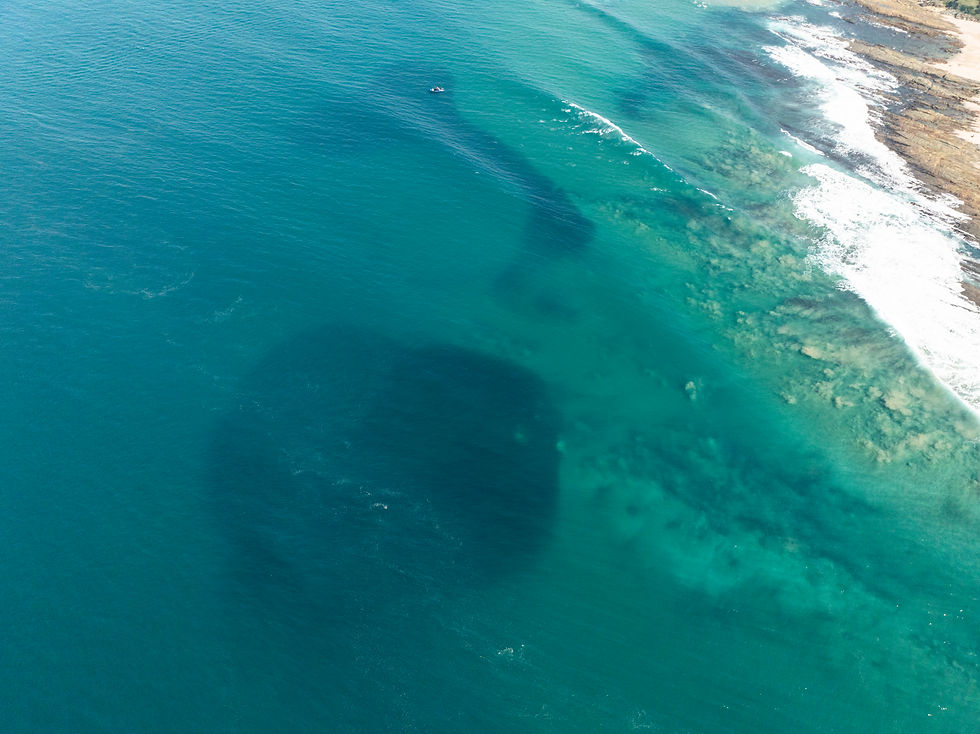
The biggest story was the sardines themselves. They were present when we arrived and were still there in huge numbers when we left. Large shoals occurred offshore, along the coastline and inside the surf zone, while enormous loose schools regularly fed naturally at the surface in what we began calling “shimmer shoals”. Despite all these sardines, 2026 was not dominated by the prolonged common-dolphin-and-gannet bait balls normally associated with the event. Instead, the season changed as warm Agulhas water pushed against the coast, and with it came a different mix of predators and behaviours.
June – Sardines everywhere
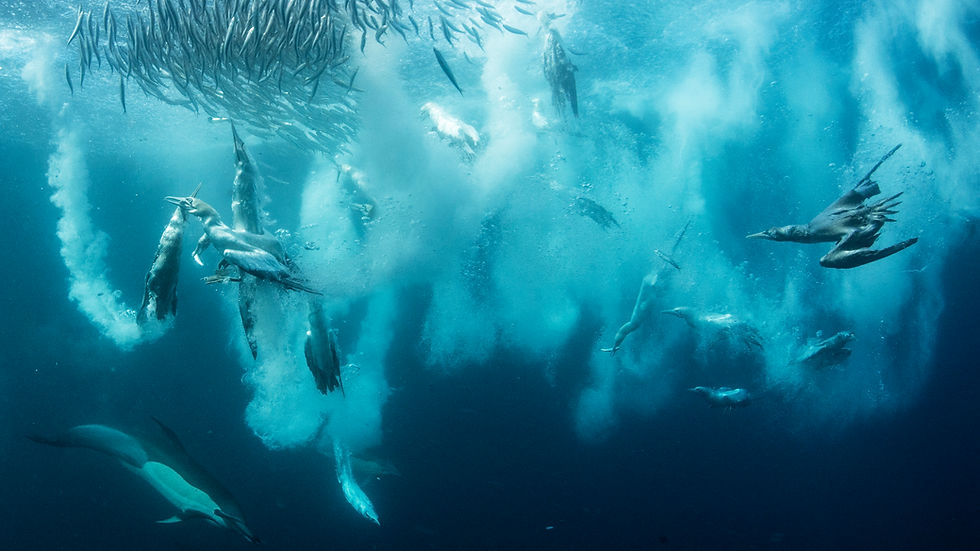
The season began extremely well. On our first days at sea there were widespread common dolphins, Cape gannets, sharks and extraordinary quantities of sardines. We encountered multiple small, fast-moving bait balls involving common dolphins, sharks and gannets, as well as rolling shark-driven feeding events. Many were fleeting, lasting seconds or a few minutes before breaking apart, but there was plenty of activity.
What stood out even more was what happened between the feeding events. Huge schools of sardines rose to the surface and fed in long shimmering streaks, sometimes over enormous areas with surprisingly little predator pressure. We could drift through schools of feeding sardines with fish extending in every direction. Instead of seeing sardines only when predators had compressed them into bait balls, we were watching the shoals themselves—feeding, travelling and behaving naturally.
By around Day Nine we experienced some of the more classic Sardine Run action. We found a sardine shoal estimated at roughly a kilometre long, with four Bryde’s whales feeding across the area and multiple common-dolphin bait balls developing throughout the day. At this stage the season still had the familiar combination of common dolphins, Cape gannets, sharks and sardines, with periods of almost continuous feeding.
June also provided the first hint of what would become another feature of the season. An oceanic manta ray passed directly beneath the boat on our first day. At the time it was simply a great sighting. By August, after encountering roughly eight mantas during the season, it looked much more like part of a broader warm-water pattern.
Late June into early July – the ocean changes
As the season progressed, the Agulhas Current strengthened and pushed warm, clear blue water unusually close to the Wild Coast. Temperatures reached around 23–24°C, and at times the blue water came directly onto the shoreline. The visibility was extraordinary, occasionally approaching 40 metres even in relatively shallow coastal water.
The clear water transformed the coastline. Reef systems normally hidden beneath murky coastal water became visible from the boat, and we encountered spinner sharks, dusky sharks, bottlenose dolphins, sardines, giant trevally, green and loggerhead turtles, stingrays and other marine life in remarkable visibility. At times there was an extremely sharp boundary between colder, murkier coastal water and the crystal-clear Agulhas water, with sardines concentrated along the colder side.

But the warm water also appeared to change the distribution of the traditional Sardine Run predators. From early July, Cape gannets and long-beaked common dolphins became noticeably less concentrated around Mdumbi. The sardines had not disappeared—in fact, they remained exceptionally abundant—but the predators most associated with classic bait balls were no longer consistently concentrated around them.
This is where the length of time spent watching the event becomes useful. I have personally worked the Sardine Run since 2008, across 18 seasons, and rarely miss a day at sea when conditions allow. I spent 40 days at sea during the 2026 season alone. At a rough average of 30 sea days per season, that represents well over 500 days actually searching for and observing Sardine Run activity on the Wild Coast. My interpretation from that experience is that the persistent warm Agulhas water was a major reason common dolphins and Cape gannets became less concentrated in our area and shifted farther south toward cooler water.
There was probably another important factor: there was simply so much food available. Sardines were distributed over enormous areas, so predators were not necessarily forced to remain attached to a single shoal. That distinction is important. Someone judging the season only by the number of large bait balls could easily conclude that sardines were scarce. From what we observed across the whole season, the opposite was true. 2026 had some of the most consistently abundant sardines I have seen in 18 years.
July – following the cooler water south
As July progressed, we increasingly had to travel south to find the larger concentrations of Cape gannets and common dolphins. On one memorable day we pushed more than 50 km south toward Dresser because the gannets had virtually disappeared from our usual search area.
Through binoculars we eventually picked up a distant line of gannets almost 10 km away and continued south. It led us to large concentrations of Cape gannets and Cape cormorants packed against the shoreline, together with spinner sharks, a loggerhead turtle and widespread shallow-water feeding activity. At other times we travelled as far as the Dwesa area, roughly 60 km south of Mdumbi, to reach cooler coastal water.
The geographical pattern was interesting. Operators farther north around Port St Johns and beyond also experienced periods with particularly low numbers of common dolphins and Cape gannets. The farther north you travelled, the greater the influence of the warm Agulhas water appeared to become. The Sardine Run had not stopped; the relationship between the sardines, predators and water masses had shifted.
July – sharks and tuna take centre stage
As classic common-dolphin-and-gannet bait balls became less frequent around Mdumbi, sharks and tuna increasingly became the dominant visible predators. Spinner sharks, dusky sharks and blacktip sharks were abundant throughout the season. We regularly saw them beneath the boat during lunch, along current lines and during drift dives, and on some days there seemed to be sharks almost everywhere we entered the water.
On 19 July we experienced one of the standout feeding events of the season. After a brief inshore event involving dusky sharks and swift terns, we spotted another eruption farther offshore. When we reached it, tuna were driving sardines upward from below while what appeared to be hundreds of spinner and dusky sharks attacked them at the surface.
The sardines were squeezed between the tuna underneath and the sharks above, producing an incredibly intense but short-lived feeding frenzy. The surface boiled with sharks and fleeing sardines. Sam Sievwright captured the underwater action while I initially photographed it from the boat before getting into the water. Within a short period, it was over.
We saw variations of this behaviour several times. Eastern little tuna appeared to play an important role in driving sardines upward, while spinner and dusky sharks exploited the fish at the surface. These shark balls were generally much shorter and more explosive than a classic dolphin-driven bait ball.
Interestingly, Cape gannets were often absent from the most violent shark balls. With so many large sharks breaking the surface, diving into the middle of the feeding frenzy would carry an obvious collision risk. Instead, swift terns worked around the edges, agile enough to take individual sardines from between the larger predators. During periods when gannets were scarce, we actually started using terns as one of our clues for locating feeding activity.
July – warm-water wildlife
The unusually strong warm-water influence was reflected in the wider species assemblage. Oceanic manta rays were one of the clearest examples. Across all my previous Sardine Run seasons I had only encountered a handful, whereas in 2026 we snorkelled with roughly eight. Several were feeding along current lines where warm Agulhas water interacted with coastal water.
Tiger sharks also appeared. Over the years we have noticed an interesting relationship between tiger sharks and Cape gannets. Occasionally tiger sharks patrol beneath gannets resting on the surface and attack them. The birds can sometimes reveal the shark before we see it, gathering tightly over one area, circling low and repeatedly looking into the water rather than diving.
During 2026 we recognised this behaviour and suspected a tiger shark might be below. Hanli Prinsloo entered the water where the birds were concentrating and located the shark, cruising less than a kilometre from shore. We also found evidence of gannet predation during the season, including dead birds and severed wings.
Another unusual encounter was the ornate sleeper ray, Electrolux addisoni, in the Hluleka Marine Protected Area. This is a rarely encountered southern African ray that was only formally described in 2007. The clear-water periods also allowed us to explore the reefs between Mdumbi, Coffee Bay and Hluleka, where we encountered ragged-tooth sharks, duckbill rays, blue-spotted rays, moonies, parrotfish, Moorish idols, butterflyfish, ladder wrasse and even lionfish. On one dive we found around 20 blue-spotted rays resting along a reef edge.
Late July – bottlenose dolphins
Bottlenose dolphins were among the most consistently abundant cetaceans of the season and became particularly prominent as common dolphins became less concentrated around Mdumbi. They occasionally formed bait balls themselves, but we also encountered large groups travelling, feeding at depth and interacting socially.
Spending so much time with them allowed us to notice behaviours that would easily be missed during shorter encounters. Animal Ocean guide Danny Jegels filmed one interesting interaction where an individual appeared to irritate other members of the pod and received a forceful physical response. We also photographed an unusually marked calf travelling among Indo-Pacific bottlenose dolphins. Its appearance was sufficiently different from a typical calf to raise the possibility of hybrid ancestry involving a common dolphin, although without genetic evidence that remains speculation.
One of the most beautiful encounters occurred during the exceptional blue-water period, when bottlenose dolphins surfed the bow waves of migrating humpback whales as the whales travelled north along the coastline. Humpbacks remained a regular background presence throughout much of the season, while Bryde’s whales were involved in some of the major sardine feeding events earlier in the year.
August – the feeding moves deeper
By the beginning of August, the season had changed again. On 1 August we encountered enormous pods of offshore bottlenose dolphins together with hundreds of spinner and dusky sharks. Yellowfin tuna also made a rare appearance, swimming among the dolphins and sharks.
What was striking was how little prey we could actually see. Almost every drop put us among predators and game fish, yet the baitfish were only occasionally visible. A considerable amount of feeding appeared to be happening deeper in the water column rather than producing obvious surface bait balls. This probably explains why some late-season days could look relatively quiet from the boat while the underwater predator activity remained extraordinary.
By then there were also very few operators left. On some days only one or two boats were working an enormous stretch of coastline. Yet the sardines were still there. Large shoals remained offshore and inshore, and the predators continued feeding on them.
5 August – the final shark ball
Our final day at sea was 5 August, and appropriately the season ended for us with another explosive shark ball off Mdumbi. Eastern little tuna drove sardines upward while spinner sharks and huge dusky sharks attacked them at the surface, producing another chaotic patch of white water, fins and fleeing fish.
Visibility was too poor to safely enter the middle of the action, so I used a long camera pole to place the camera underwater and record the feeding. It was a fitting final encounter because it represented the unpredictability of the entire event. The Sardine Run does not wait for good visibility, good weather or a photographer to be ready. You need the equipment, range and experience to adapt to whatever happens.
Most importantly, this was happening in early August, almost two months after we had arrived. The sardines were still abundant and the predators were still exploiting them. There had been no clean end to the migration while we were there. We simply eventually had to leave.
Looking back at 2026
The 2026 Sardine Run was not the biggest classic bait-ball season we have experienced, but it was one of the most interesting. Sardines remained extraordinarily abundant from June into August, while the ocean around them changed. Early in the season we had the more familiar common dolphins, Cape gannets and concentrated feeding activity. As the Agulhas Current strengthened and warm water pushed against the coastline, the common dolphins and gannets became less dominant locally, while sharks, tuna, bottlenose dolphins, manta rays and other warm-water animals became increasingly prominent.
The most important point is that fewer prolonged bait balls did not mean fewer sardines. In 2026, it almost meant the opposite. There were sardines everywhere. The feeding was simply more dispersed, sometimes deeper and increasingly dominated by a different combination of predators.
After Animal Ocean's 18 seasons following the event, 2026 stands apart as the year of extraordinary sardine abundance, warm Agulhas water, sharks and blue water. It was another demonstration that there is no single version of the Sardine Run. Every season is shaped differently by currents, temperature, prey abundance, predator distribution, weather and chance, and you only really begin to appreciate those differences by spending a lot of time out there watching the event unfold. Writer credentials : Steve Benjamin is a zoologist, underwater cameraman and founder of Animal Ocean. He has worked on the South African Sardine Run for 18 seasons since 2008 as well as filmed or assisted with wildife projects for BBC, Nat Geo, NHK, Netflix and is a Nauticam ambassador

While taking a break from the odds at https://verificationfreecasino.net, I found this sardine run overview just as unpredictable. The detail that huge "shimmer shoals" fed naturally without predator pressure really stuck with me—it's a reminder that abundance doesn't always follow the expected script. In my own work, I've learned that when conditions shift, the old patterns often give way to something just as impressive, if you're paying attention.
Been browsing Poki Games when I need to unwind after long study sessions. They organize everything by category which makes it easy to find something that matches your mood. The multiplayer section has some surprisingly fun stuff too.