

Scuba or Snorkeling on the Sardine Run: Which Is Better?
After 18 years of working on and leading expeditions on the South African Sardine Run, there is one question I get asked more than almost any other: Is it better to scuba dive or snorkel on the Sardine Run?
The simple answer is that both are possible, but they are not equally effective. The Sardine Run is not a normal dive trip. You are searching a huge stretch of coastline for fast-moving, unpredictable feeding activity, and once you find it, everything can change within minutes. Your ability to travel, react, get into the water quickly and then move again can determine how much you actually see.
This is my personal opinion, based on 18 seasons of doing this in the real world with groups of divers, photographers and filmmakers.
Scuba Diving on the Sardine Run
The biggest advantage of scuba is time underwater. Once you are down, you can stay there and allow the action to unfold around you rather than repeatedly returning to the surface. This can be particularly valuable for professional filmmakers. If you are trying to hold long, steady shots and allow animals to move naturally through the frame, scuba can be an important tool.
Scuba can also give you another activity during quieter periods. If the inshore visibility is good, there may be opportunities for reef dives while searching for Sardine Run activity. The problem is that good inshore visibility is far from guaranteed during winter on the Wild Coast.

The disadvantages of scuba become obvious when you look at how the Sardine Run actually works. Tanks, BCDs and the associated equipment make the boat considerably heavier and take up a lot of space. A heavier boat is slower, has reduced range and is less manoeuvrable. On the Sardine Run, where we can travel considerable distances looking for activity, that matters.
More importantly, scuba is slow. Getting six to eight divers into their equipment and safely into the water takes time. Getting them all back onto the boat takes time again. If the bait ball moves, breaks up or another patch of activity develops a kilometre away, you cannot simply gather everyone together and chase it.
This is one of the biggest misconceptions about scuba diving on the Sardine Run. People imagine descending onto a huge, perfectly stationary bait ball and spending an hour watching sharks, dolphins, gannets and other predators feeding around them. Those bait balls certainly can happen, but you cannot build an expedition around waiting for the perfect one. Much of the Sardine Run is mobile, fragmented and unpredictable, and in reality there are relatively few situations where scuba gives you a meaningful advantage over snorkeling.
Scuba diving also requires a very high level of diving ability. You may be diving in low visibility, in open water with no bottom reference, controlling your buoyancy at five to ten metres while surrounded by large sharks and rapidly moving animals. Your orientation, situational awareness and buoyancy need to be excellent.
There is also a significant safety consideration. On scuba, your guide cannot communicate with you nearly as effectively as when everyone is snorkeling at the surface. A Sardine Run guide needs to be watching the animals, watching the group, identifying developing hazards and communicating when people need to move, regroup or get out of the water. That entire process is considerably easier when the group is snorkeling.
In my experience, sharks can also be far more curious around scuba divers than snorkelers. On scuba you need to be comfortable with very close shark encounters and capable of remaining calm and aware when large sharks approach. We minimise obvious visual contrasts by using black fins, black gloves and avoiding white or highly contrasting patches of equipment. In situations where close approaches are expected, an experienced guide may also carry a shark prodding stick, and divers need to work together so that someone is watching behind them as well as ahead.
This is not ordinary recreational diving. You need to be an extremely competent diver and prepared for difficult open-water conditions and close encounters with large sharks.

For that reason, scuba makes the most sense when someone has privately hired a boat, when the entire group is dedicated to scuba, or when a professional filmmaker specifically needs the extended underwater time. For a cameraman who needs to hold a position and wait for behaviour to develop, the advantages can outweigh the disadvantages.
Snorkeling and Freediving on the Sardine Run
For most Sardine Run groups, snorkeling and freediving work considerably better.
The greatest advantage is speed. You can get into the water almost immediately, get back onto the boat quickly and move with the action. If a bait ball breaks apart and reforms somewhere else, everyone can be back aboard and moving within minutes.
The boat is also lighter. Without eight sets of scuba equipment, there is more space and less weight, which means greater range, speed and manoeuvrability. When you are spending an entire day searching coastline for predators, those advantages add up.
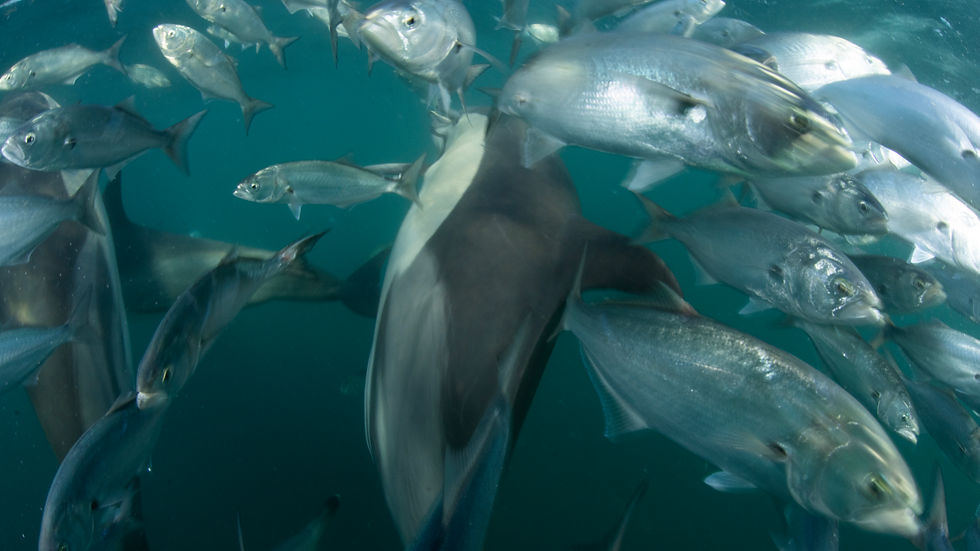
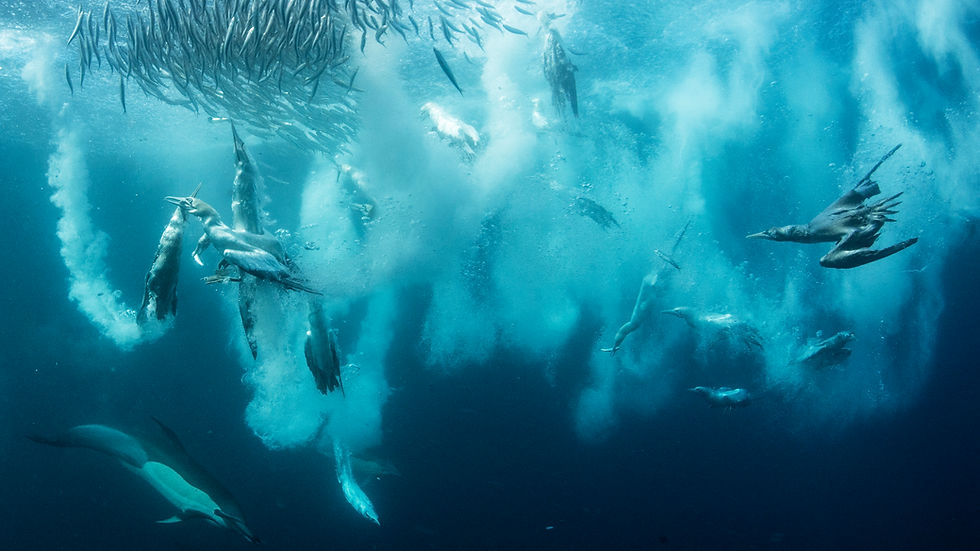
Most importantly, the feeding behaviour we are looking for is generally concentrated near the surface. Dolphins drive fish upwards, sharks attack through the bait, gannets plunge down from above and whales may lunge through the aggregation. You do not necessarily need to be sitting ten metres underwater to experience the action.
There is also an important safety advantage. Snorkelers remain predominantly at the surface, where the guide can see the group, communicate directly and respond quickly if the situation changes. Guests can hear instructions, regroup rapidly and return to the boat if necessary. On the Sardine Run, where conditions and animal behaviour can change quickly, communication is one of the most important tools a guide has.
Snorkelers also take up less underwater space. Rather than having divers positioned at different depths or potentially surrounding a bait ball, the group remains predominantly at the surface with a guide. This gives the predators more room and makes it easier for the guide to manage everyone's position around the activity.
The disadvantage is that snorkeling does not give you the same ability to stay underwater and simply wait. Unless you are a competent freediver, your underwater encounters are relatively short. For a professional cameraman trying to hold a long, stable sequence, that can be a significant limitation.
For most photographers and guests, however, I think the increased number of opportunities more than compensates for the shorter individual dives. I would rather have a group able to respond quickly to ten opportunities during the day than spend large amounts of time gearing up and recovering divers while the activity moves away.
Pony Bottles: A Middle Ground
There is a third option that can work extremely well for the right people: small aluminium pony bottles, typically three- or five-litre cylinders.
We essentially treat this as snorkeling rather than conventional scuba diving. A highly competent photographer or diver can descend to around five to eight metres, spend a little longer underwater photographing the activity, then return to the surface and continue moving with the group. It gives you some of the extended underwater time of scuba without committing the whole group to a conventional scuba deployment.
This can be a very effective middle ground, particularly for experienced underwater photographers. You retain much of the mobility that makes snorkeling so successful while gaining slightly longer periods at shallow depth when something worthwhile is happening.
But this is not an option for the average guest. We only consider it by special request for people bringing their own personal equipment who can demonstrate an extremely high level of competence underwater. The same environmental and animal hazards remain. You are still operating in open water, often without a bottom reference, and sharks can still approach closely. Being on a small cylinder does not remove the need for excellent awareness, buoyancy, orientation and shark awareness.
It also only works with a competent, cohesive team. The moment pony bottles start slowing down the entire group, they defeat their purpose.
The Group Has to Work as a Team
This brings everything back to perhaps the most important point: the Sardine Run is a team activity.
You might have eight guests on a boat, but you still have one boat. The skipper needs to position it, the guide needs to assess the activity and the group needs to deploy and return efficiently. If something better starts happening somewhere else, everybody needs to be able to move.
Trying to run conventional scuba divers and snorkelers from the same boat is therefore extremely difficult. Snorkelers may be ready to chase another bait ball while scuba divers are still underwater. The boat cannot simply leave. Opportunities are lost and the cohesion of the group starts to disappear.
Whichever method you choose, the whole boat should ideally be doing the same activity. That makes the group easier and safer to manage and maximises everyone's opportunities.
So, Which Is Better?
After 18 seasons, my conclusion is fairly straightforward. For the average Sardine Run guest, snorkeling and freediving are by far the better option. The boat is lighter and faster, you can travel further, you get into and out of the water quickly, communication with the guides is better, and you can keep up with an event that is constantly changing.
Scuba diving has a place, particularly for professional filmmakers, highly experienced private divers or a dedicated scuba group that encounters a large, stable bait ball. But scuba is slower, more cumbersome and there are simply fewer situations during a typical Sardine Run where its advantages outweigh the opportunities you lose through reduced mobility.
Small pony bottles provide an interesting middle ground for exceptionally competent photographers and divers, allowing slightly longer periods at shallow depth while retaining much of the mobility of snorkeling. But they are a specialist tool, not something we offer as a normal option to guests, and the additional awareness required around sharks remains.
Ultimately, three things matter. The group needs to be doing the same activity. Snorkeling works best for the vast majority of Sardine Run encounters. And whatever method you use, mobility, communication and teamwork are what maximise your opportunities.
The Sardine Run doesn't wait for you to get ready. When the action happens, you need to be ready to move with it. Writer credentials : Steve Benjamin is a zoologist, underwater cameraman and founder of Animal Ocean. He has worked on the South African Sardine Run for 18 seasons since 2008 as well as filmed or assisted with wildife projects for BBC, Nat Geo, NHK, Netflix and is a Nauticam ambassador
Result sharing adds a social and practical advantage to a calorie calculator. Whether someone wants to compare goals with a friend or discuss their estimated intake with a fitness partner, the calculated information can be passed along effortlessly.
Online training can make educational resources available beyond traditional classroom hours. Students who prefer studying in the morning, afternoon, evening, or during weekends may find flexible scheduling useful. This flexibility allows learners to choose study periods when they can concentrate effectively. However, successful online learning still requires commitment. Setting regular study goals, avoiding security guard school unnecessary distractions, completing assessments, and reviewing difficult subjects can help students make steady progress toward completing their security training requirements.
I keep a tab open with Crazyig for when I need a break during work. They have a decent collection of browser games that run smoothly without any lag. The racing and shooting categories are where I usually end up spending most of my time.
hi